How founder Khansa Khatoon is using technology to bring intentionality to everyday dressing.
Written by Ifrah Akhtar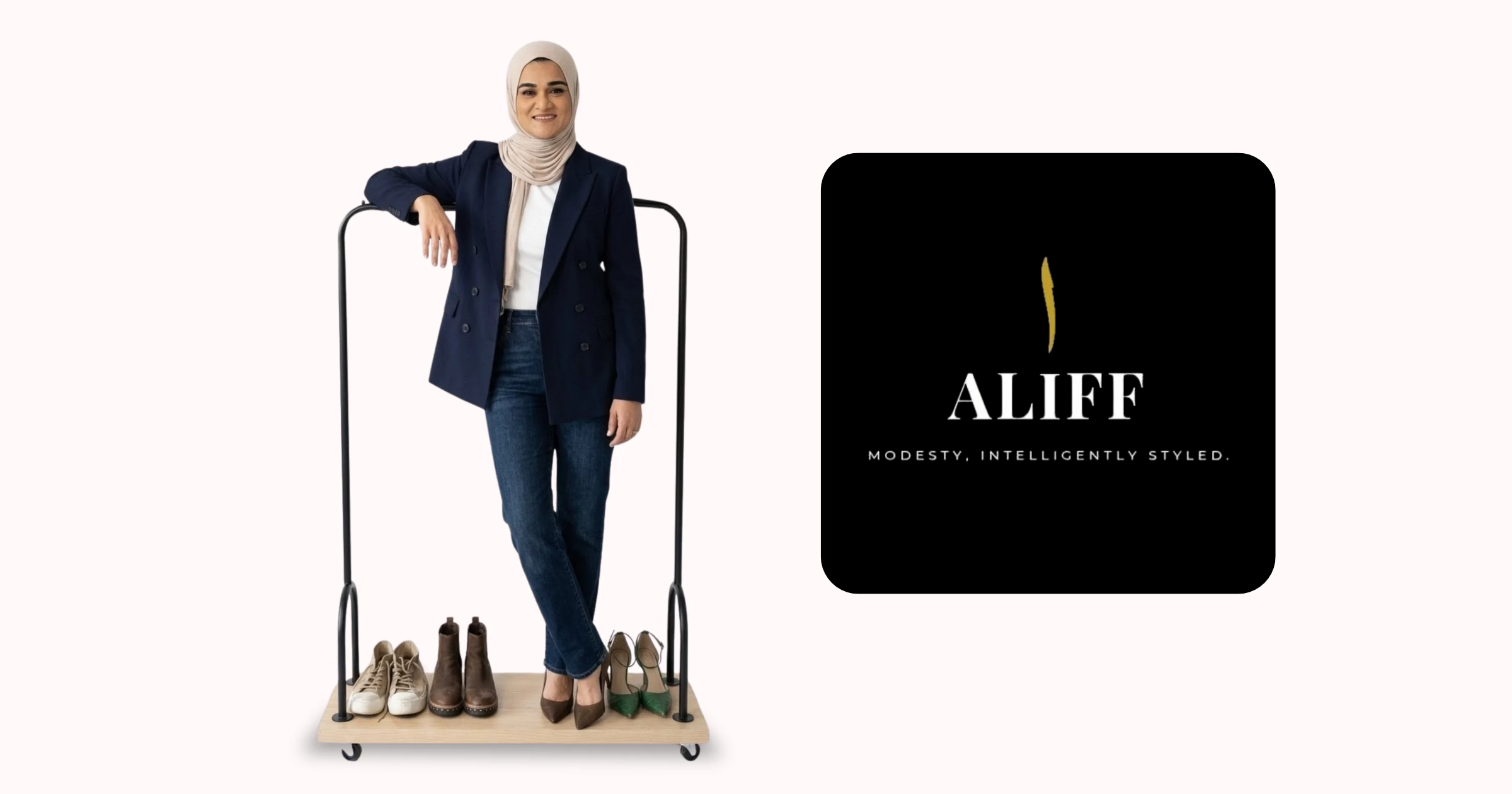
Image courtesy of Khansa Khatoon
At some point, almost every fashion lover imagines having a personal styling assistant like Cher’s closet in Clueless. That moment when you don’t know what to wear, are overwhelmed by the options in your closet, but then technology steps in to save the day with a great outfit.
This year, Dallas-based founder Khansa Khatoon made that tool a reality.
Launched globally on iOS and Android in July 2026, ALIFF is an AI-powered personal styling app designed specifically for Muslim women and modest dressers. At a time when artificial intelligence is rapidly reshaping how consumers shop and get dressed, Khatoon designed the app to solve a very specific problem, helping users style the clothes they already own without compromising on their personal definition of modesty.
Born and raised in India to a fourth-generation business family, Khatoon is a first-generation American who spent nine years working as a creative strategist, food photographer, and digital marketer before conceptualizing ALIFF in 2025. Despite coming from a non-technical background, her inspiration was personal.
“I founded ALIFF because I’m the user. I started wearing hijab two years ago,” Khatoon says. While traveling outside the United States, specifically in Malaysia, the idea clicked. “The women there were so particular about how they wore their hijab and were so put together every day; it made me realize how much intention goes into modest dressing and how little of that intention had ever been built into a styling tool.”
Noticing women experimenting with emerging AI technologies like Gemini and ChatGPT to brainstorm outfits, Khatoon saw an opening to build something with intention. “We don’t have a tool that serves Muslim women, that gives people the real solutions,” she explains. “I want ALIFF to understand the nuances of dressing modestly but also give outfit suggestions for all people using it.”
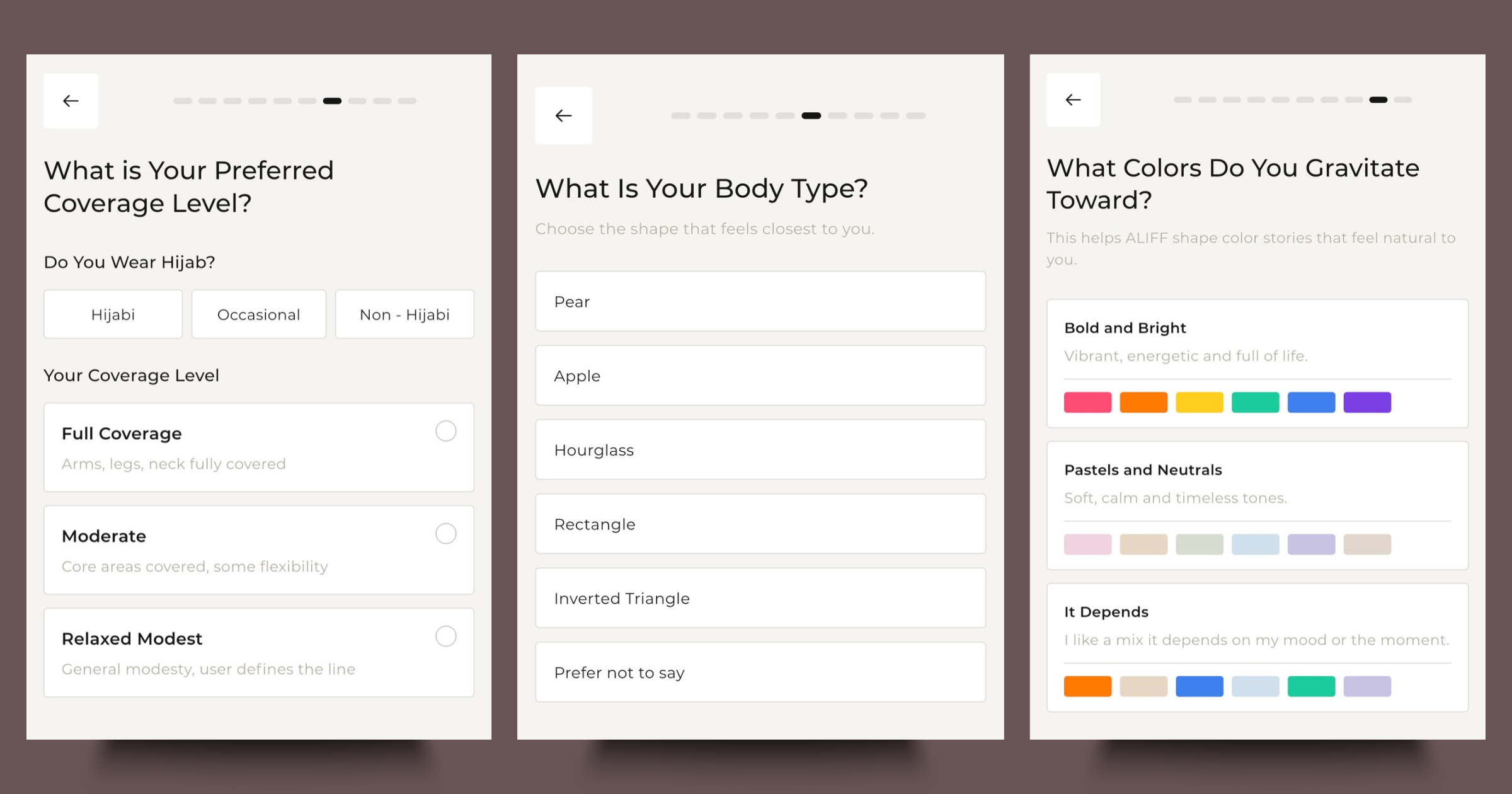
Screenshots of some of ALIFF”s onboarding questions
Finding a balance with AI
The integration of artificial intelligence into styling reflects broader movements across the global fashion ecosystem, where technology is increasingly used for consumer discovery and personal curation. As the Global Fashion Agenda noted in an analysis: “AI is neither inherently sustainable nor unsustainable. It reflects the intentions of those who deploy it. Used to forecast demand, design out inefficiency, and enable circular systems, it can be a genuine driver of progress. Yet when directed toward accelerating production or fuelling hyper-personalized marketing, it risks reinforcing the same cycles of overproduction and waste that sustainability efforts seek to overcome.”
It is a fine balance, and the laws surrounding AI regulation, in the fashion industry and at large, are not moving fast enough with how the tech is evolving.
“This tool is about understanding modesty and encouraging Muslim women to use what they already own.”
For Khatoon, building ALIFF meant leaning into a circular mindset rather than pushing constant consumption. “None of us are going to escape it. We’re living in times where everyone is using AI; everything about fashion and shopping is integrating AI,” she says. “This tool is about understanding modesty and encouraging Muslim women to use what they already own. It’s about finding a balance in using this technology.”
The user experience on ALIFF begins with an onboarding quiz asking about coverage level, whether the user is a hijabi, skin tone, body type, and more. After selecting a monthly ($12.99) or annual ($9.99/month) plan, users upload photos of their clothes to generate a digital closet. Then they can chat with ALIFF, the AI stylist for quick daily styling or in-depth looks for events.
Turning wardrobes into a styling resource
During early beta testing, this focus on personalized wardrobe use stood out compared to static wardrobe-organizing apps.
“It essentially turns my existing wardrobe into a styling resource,” says Rebaica Safiya, a Dubai-based PR and communications professional who tested the app. “Instead of looking at everything I own and still feeling like I have ‘nothing to wear,’ I can use the app to discover different ways of putting those pieces together based on the occasion, weather, time of day, or even my mood. I also like that the recommendations aren’t fixed. If there’s something about a suggested outfit that I don’t like…I can communicate that back to the AI and refine the look.”
Nour Elhouda, a Tunisian fashion designer, art director, and stylist based in Milan, consulted with Khatoon early on to bring a professional styling lens to the app. For Elhouda, the app’s value lies in teaching users why certain combinations work and suggesting missing accessories like bags, jewelry, or a different hijab to guide smarter future purchases.
“As someone working in fashion and styling, I know that one of the biggest challenges people face isn’t necessarily a lack of clothing, but knowing how to make the most of what they already own,” Elhouda says. “Not everyone has the opportunity to work with a personal stylist, and having a tool that helps you rediscover your wardrobe, experiment with combinations you might not have considered, and gradually understand your personal style better can make a meaningful difference.”
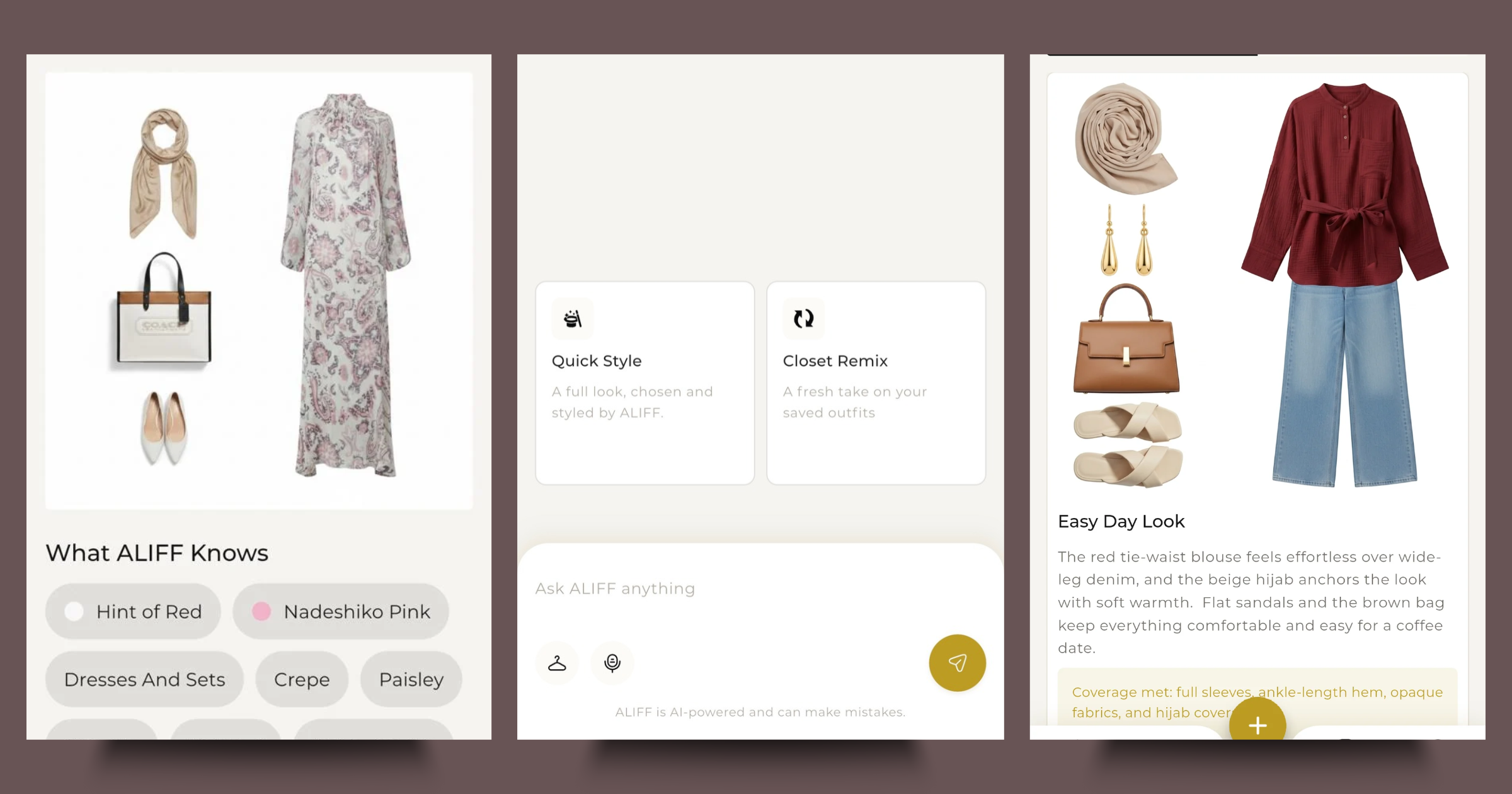
Left to right: An outfit ALIFF designed for Safiya. Screenshot of the chat interface. Outfit designed for Khatoon with a description. Images courtesy of Rebaica Safiya and Khansa Khatoon.
Khatoon herself relies on ALIFF to push her personal style boundaries, like choosing bold colors or pieces she wouldn’t normally reach for in her closet. She wore one of the outfits ALIFF styled for her to EmpowherCon 2026 in Dallas this past April.
Following the app’s summer launch in July and a September presentation at the Women Shaping Wealth Summit in Riyadh, she is expanding into the Middle East and North Africa (MENA) and Gulf Cooperation Council (GCC) markets while developing community features reminiscent of the late styling app Polyvore—allowing users to style and share avatars using a strictly positive, upvote-only system.
Khatoon hopes ALIFF will shift how women view both technology and their own closets. “I hope this app helps people use what they already have or to identify gaps they may have in their wardrobe,” she says. “Technically, anyone can use this app, but it’s built specifically for Muslim women because we don’t have many tools made exclusively for us.”
Ultimately, ALIFF represents both a tailored solution and a broader movement towards what conscious fashion consumption could look like when powered by technology.